Rolez with it!
There were the freres Japy. The Brocot family. A few others.
Here's a very understated, silk-thread suspension (remember from my last post?) Japy Freres black slate mantle clock that I've been ogling:

Lovely.
But let's get back to the protagonist of our story... Monsieur Jules Rolez.
Turns out he is a bit of an elusive fellow.
If you Google "Jules Rolez clock" the results page says it's
"Showing results for jules rolex clock"
and you have to click the link below that line that says
"search instead for jules rolez clock."

Even after clicking the "Search instead" link Google still offers a link up top that says
"Did you mean: jules rolex clock."
No!
It's like they don't even want you to find those clocks.
Ok I get that Rolex is quite a better well known name in timekeeping but still...
Anyway once you get through all that you'll see some example's of Monsieur Rolez's wares. As I write this, searching for a Japy Freres clock on eBay results in 174 clocks you could buy.
Try Jules Rolez clock. I got exactly one (1) clock. Pretty sure it's been that same clock for months now. Not a lot of them out there for sale.
Nor is there much info on Rolez nor his company. Scouring the NAWCC boards I finally did find a little slice of info on him:
“Jules Rolez, Paris, became known through the production of chimney clocks [AKA Mantle clocks, ed.] and was active around 1900. The factory was located in Saint-Aubin-sur-Scie, near Dieppe and Saint-Nicolas d'Aliermont. Maybe he used "Blancs Roulants" from this place. However, the "Mouvements de Paris" (French Penduleworks) were marked with a stamp Jules Rolez Limited Paris. According to information he also had relations to England in Manchester and presumably a sales outlet in Lancaster Avenue, Fennel Street 17 & 19. Rolez shares were also issued in English.”
So he was busy around the turn of the last century and had an operation in England as well. Still it's hard to find his clocks today.
Those Blancs Roulants mentioned are the basic components of clock movements; the round plates and springs only. Think of just a raw frame of a car; not even an engine, much less wheels, etc.
Since France was making thousands of clocks annually many base components of French clock movements were made in bulk all over France. No wheels (gears), pendulums, etc. Full movements were finished with all the pieces to run the clock. Many clock makers focused on their cases and less on movements. They'd buy the Blanc Roulants and modify them to their clock designs.
The Mouvements de Paris are complete movements that were made in their entirety in one factory from the plates on up and thought to be of higher quality, not all strictly made in Paris but certainly in France. Production at scale began during Napolean's time and wound down by the early 1900's. Some examples:
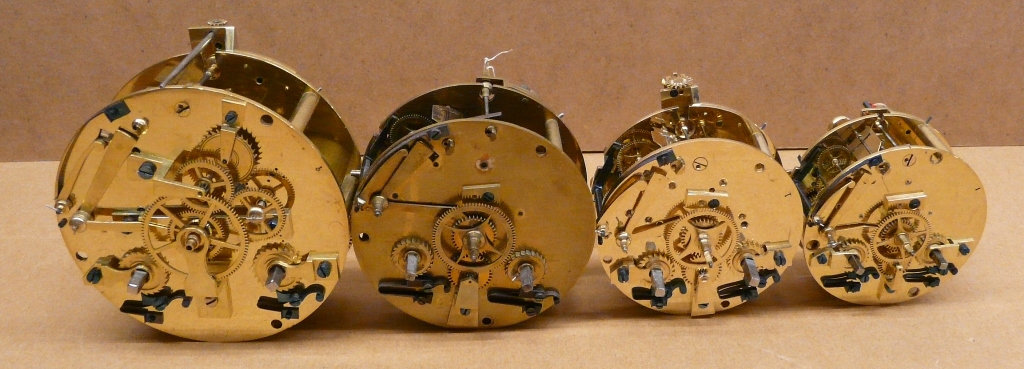
Remember that stamp on my Jules Rolez? The Paris mark means it is a Mouvement de Paris, completely built from the plates on up by Rolez.

Here is the movement out of the case and in my hand. This is the side opposite the stamped plate:

Back to styles... some of the early popular versions included the boulle, the comtoise, the cartel, the unusual oeil de boeuf, the regal portico... the list goes on. Many of these styles were quite ornate and surviving examples can go for big bucks. I saw one recently and the asking price was $84,000. Yep.
In the late 18th century gothic revivalism swept Europe. Many clock designs became more subdued. Clock cases started to get darker, some mimicking gothic cathedrals and castles. This became even more popular curing the Art Deco era where figurines on clocks became more popular. Some those castles were even protected by knights like those on this fellow I saw at an estate sale:

The seller wanted $300. I haven't been willing to pay much for clocks (more about repairing them) and, in my dallying, missed the opportunity to grab it. I wish I was more decisive in the moment.
Quel dommage. Those knights are jaunty.

Anyway the Gothic style permeated clock designs of all kinds including dials, and more specifically, clock dial fonts. Like so:

That dial is porcelain around a brass center with hand painted numbers and marks. Note the hairline cracks on the 11. (BTW I think the black washer under the pin that holds the hands is a replacement, and a poor choice at that.)
Anyway back in the late 19th century there was also a surge in "mantel" clocks that were easier to place in many locations in the home versus say hanging one on the wall or finding a spot for a large tall case (AKA grandfather) clocks. Along the stone castle / gothic theme, marble became a popular but relatively expensive material for clock cases. Many makers also used black slate. Elegant but also less expensive than marble.
So by the late 19th and then well into the early 20th century there was a surge of slate mantle clocks, many still with a touch of the Gothic like my Rolez.

Yes the slate is very washed out on the face especially. I think somebody tried to clean it with the wrong cleaner. The lighting makes it look quite a bit worse than it appears in real life but still. Definitely needs restoration. No that's a different clock movement on the stand next to it. An American clock but that's another post.
So there is a French-made, Mouvement de Paris, gothic-influenced, black slate, mantel Jules Rolez clock built probably in the late 1800's. Given how little there is out there about Rolez, I may never be able to get more precise than that.
The more thing is you'll see that it is not all slate. The columns and left and right caps are a green marble.

Your amateur horologist is having great fun learning by doing.
Here's one extra bit of fun...
Remember that NAWCC board post about the Rolez company I found? The last sentence mentions the company shares "were also issued in English."
Voila:

So far this has been more than $60 worth of fun...
More to come.


No one man should have so much fun .... except me, of course.
ReplyDelete